



Share This Article
Ask ten people what makes a relationship last and you will get ten confident answers. Shared values. Communication. Never going to bed angry. Marrying your best friend. Finding someone with the right personality.
Almost all of it is folklore. Not malicious, not stupid, just untested, passed between people who had no way of checking and no particular reason to doubt it.
In 2020, a team of 86 researchers finally checked. They pooled 43 separate long-term studies of couples, covering 11,196 relationships, and threw more than 2,000 variables at the question using machine learning. It remains the largest attempt anyone has made to answer this.
The results are genuinely surprising, and the most surprising part is the one that almost never gets reported.

The short version
- The strongest single answer to what makes a relationship last is believing your partner is committed to you.
- The top five predictors are all about the relationship itself, not about either person’s personality.
- Your partner’s individual traits add almost nothing once you know how the relationship feels from the inside.
- Personality, attachment style and demographics were roughly two to three times less predictive than relationship-specific factors.
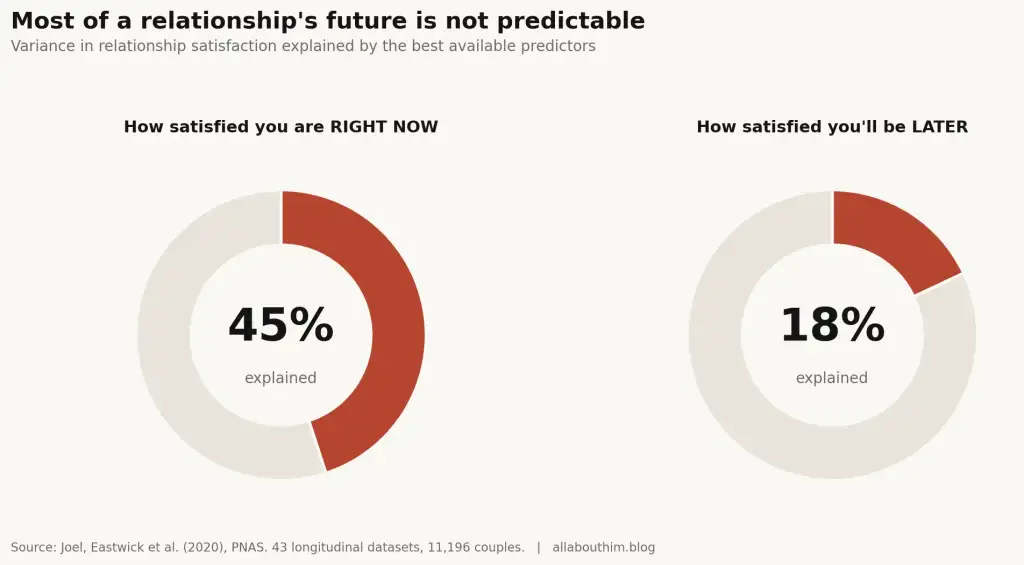
- Together, the best predictors available explained about 45% of current satisfaction and only about 18% of future satisfaction.
- Which means most of what happens to a relationship is not visible in advance, no matter how good the data is.
The study that finally tested what makes a relationship last
Relationship research has a long-standing problem. Most studies are small, run by a single lab, and test whichever variable that lab happens to be interested in. A researcher who studies attachment finds attachment matters. A researcher who studies conflict finds conflict matters. Nobody could say which mattered more, because nobody had them in the same analysis.
Samantha Joel at Western University and Paul Eastwick at UC Davis decided to fix this by asking essentially everyone in the field to hand over their data.
84 other researchers agreed. The result, published in the Proceedings of the National Academy of Sciences, pulled together 43 longitudinal datasets from 29 different laboratories, covering 11,196 couples.
How it was built
The inclusion rules were strict, and the strictness is what makes the result worth trusting.
Data had to be longitudinal, meaning couples were tracked over time rather than surveyed once. It had to include both members of the couple, not one person describing the relationship alone. And it had to contain a proper measure of relationship satisfaction.
Into that went more than 2,000 variables, sorted into three families. Things about the relationship, such as appreciation, conflict, sexual satisfaction, investment and supportiveness. Structural facts, such as whether the couple lived together, were married, and how long they had been together. And things about the individuals, including personality traits, anxiety, attachment style, alcohol use, family history and demographics.
Rather than testing each variable one at a time, the team used a machine-learning method called Random Forests, which is well suited to finding which predictors carry real weight when thousands are competing. Crucially, the models were tested on data they had not been trained on. That matters, because it is exactly the safeguard missing from some famous earlier work in this field, where models fitted to known outcomes produced impressive numbers that did not survive contact with new couples.
This was, in short, the version of the question that had never been asked properly.
Eighty-six researchers, 29 laboratories, 11,196 couples, 2,000 variables. If the answer were in the data, this is the study that would have found it.
What the data says about what makes a relationship last
Five relationship-specific variables came out on top, consistently, across datasets. Here they are in order, with what each one actually means.
1. Perceived partner commitment
The single strongest predictor. And note the word “perceived.”
What predicted satisfaction was not how committed the partner reported being. It was how committed the person believed their partner to be. The belief did the work.
This is more actionable than it first appears. A man can be entirely committed and produce almost none of the benefit of it, because commitment that is never visible cannot be perceived. Turning up, staying, not leaving during hard periods: these are demonstrations, and they register. Feeling committed privately does not.
It also explains why relationships with a persistent undercurrent of doubt struggle even when nothing is actually wrong. If one person is not certain the other is fully in, the uncertainty itself degrades the relationship, whether or not it is warranted.
2. Appreciation
Feeling appreciated by your partner came second. Not being appreciated. Feeling it.
The same pattern as commitment, and the same practical implication. Appreciation that is felt but not expressed does not reach the other person, and therefore does not count. This is the finding that makes the small, repeated, slightly awkward business of saying thank you for ordinary things look considerably less trivial than it feels.
3. Sexual satisfaction
Third, and worth stating plainly because people often hedge around it. Sexual satisfaction was among the most robust predictors of relationship quality across 11,000 couples.
The direction of causation is not settled, and anyone claiming otherwise is going beyond the data. Happy couples may have better sex, better sex may make couples happier, and both are almost certainly true at once. What the study establishes is that this is not a peripheral matter that healthy couples transcend. It sits near the centre.
4. Perceived partner satisfaction
Believing your partner is happy with the relationship. Again perceived, again more powerful than the reality.
There is a quiet loop hiding in these top four. Your satisfaction depends heavily on believing your partner is satisfied and committed. Theirs depends on believing the same about you. Two people can therefore drift downward together purely through mutual misreading, with neither one actually less committed than before.
5. Conflict
Conflict made the top five, in the negative direction. More conflict, lower relationship quality.
What is notable is where it ranks. Fifth, behind four things that are about perception rather than behaviour. The popular model of relationships treats conflict as the main event and everything else as background. The data suggests the reverse: conflict matters, and it matters less than whether each person believes the other is in this.
How conflict is handled is a separate question, and it is where the mechanics of withdrawal during conflict do their damage.
What barely mattered at all
This is the half of the study that got almost no coverage, and it is the more useful half.
Your partner’s characteristics
Here is the finding that should reorganise how people think about this.
Once the researchers knew how a person rated their own relationship, adding information about their partner’s individual characteristics added very little to the prediction. Not zero. Very little.
Think about what that undermines. The entire premise of assessing a potential partner’s traits to determine whether the relationship will go well is, at minimum, far weaker than assumed. The personality checklist, the compatibility matrix, the list of qualities to look for: none of it performed well against how the relationship actually felt from the inside once it existed.
Personality and individual differences
Individual traits did predict something. The strongest were life satisfaction, negative affect, depression, attachment avoidance and attachment anxiety. A person who is broadly unhappy, anxious or depressed tends to report lower relationship quality, which is unsurprising and worth knowing.
But relationship-specific variables were roughly two to three times more predictive. And in the researchers’ own framing, once the relationship-specific data was in hand, the individual differences faded into the background.
Joel’s summary was that the two-to-three-times gap probably matches most people’s intuitions. The surprising part was how completely individual differences receded once relationship variables were accounted for.
The structural facts
Whether a couple lived together, were married, or how long they had been together carried far less weight than the texture of the relationship itself. The categories people use to describe their relationship status turn out to say remarkably little about its quality.
The finding nobody reported
Now the part that reframes everything we know about what makes a relationship last
All of those predictors together, the best 2,000 variables that relationship science has produced across decades of work, explained up to about 45 percent of relationship satisfaction as measured at the same time.
And up to about 18 percent of satisfaction measured at the end of each study.
What those two numbers actually mean
The 45 percent figure is a decent achievement for psychology and it comes with an important limitation: it describes current satisfaction using current information. Asking someone how appreciated they feel and then predicting how satisfied they are is partly measuring the same thing twice.
The 18 percent is the number that matters, because that is prediction proper. Knowing everything about a couple today, the best available science accounts for less than a fifth of where their satisfaction lands later.
Which leaves roughly 82 percent unaccounted for.
Some of that is measurement error, since all of this rests on self-report questionnaires. Some is variables nobody measured. And some, probably a great deal, is simply what happens to people. Illness. Job loss. A death. A move. A child. Circumstances arriving from outside the relationship and reshaping it in ways no baseline survey could anticipate.
Headlines described this study as revealing the secret to lasting relationships. It is closer to the opposite. It is the most rigorous demonstration available that relationships are substantially unpredictable, produced by the people best equipped to predict them.
The best data science has on relationships accounts for less than a fifth of where a couple ends up. The rest is life arriving.
What this means if you are a man reading it
Four consequences of what makes a relationship last, worth sitting with.
Stop auditing her and start looking at the relationship. The instinct to evaluate a partner’s traits, to work out whether she is the right sort of person, performs poorly. What predicts your satisfaction is what is happening between you, and that is not a fixed property of anyone.
Commitment has to be visible or it does not count. This is the finding most likely to be relevant to men specifically, because a lot of men understand commitment as a settled internal fact rather than something requiring ongoing demonstration. You decided, therefore it is decided. But the predictor is your partner’s perception, and perception runs on evidence. If she cannot see it, the relationship does not get the benefit of it.
Appreciation is a transmission problem, not a feeling problem. Most men in long relationships appreciate their partners. Considerably fewer say so at a rate the other person can detect. The gap between the two is not affection. It is reporting frequency.
You cannot secure this in advance. With 82 percent unexplained, there is no configuration of choices at the start that locks in the outcome. This is either alarming or liberating depending on temperament. It means the work is ongoing rather than front-loaded, and that a relationship which looks unpromising on paper is not thereby doomed.
One related note. Men who route all emotional life through their partner tend to overweight the relationship’s day-to-day temperature, because it is the only reading they have. The friendship recession makes this worse, and it is one of the few things on this list you can change unilaterally.
What the study cannot tell you
Four limits on what this study can tell you about what makes a relationship last, stated plainly.
It is correlational, not causal. Appreciation and satisfaction travel together. The study cannot establish which produces which, and the honest answer is probably both, circling.
All of it is self-report. Every variable came from questionnaires. Nobody was observed. People’s accounts of their own relationships are shaped by mood, by recent events, and by what they want to be true.
The samples were Western. The couples came from the United States, Canada, Switzerland, New Zealand, the Netherlands and Israel. The researchers say directly that other cultures need separate investigation, and it would be unwise to assume these rankings transfer unchanged to societies where marriage is arranged differently, where extended family plays a larger role, or where the expectations placed on a partnership are structured differently.
It measured satisfaction, not survival. Satisfied couples and couples who stay together overlap heavily, but they are not the same group. Plenty of unhappy relationships persist for decades, for reasons this study was not designed to capture.
What to actually do with this
Four things, in order of how strongly the evidence supports them.
1. Make commitment legible
Say it out loud occasionally, and more importantly behave in ways that demonstrate it during the periods when it would be easiest not to. Commitment is inferred from behaviour under strain, not from statements made when things are easy.
2. Raise the transmission rate on appreciation
Specific beats general. “Thank you for handling the school run all week” lands, “I appreciate you” mostly does not, because the second is too abstract to serve as evidence of anything.
Frequency matters more than eloquence. This is a volume problem.
3. Treat sexual satisfaction as a real variable
Not as a symptom that will resolve when everything else is fixed, and not as something mature couples stop caring about. It ranked third out of 2,000.
4. Reduce conflict frequency, not just conflict intensity
Conflict made the top five as a quantity. Managing it well is valuable, and having less of it is also valuable, and the second is easier to influence than most couples assume once the same three arguments are identified and addressed at the source.
Worth noticing what is absent from this list. Nothing about finding the right person. Nothing about compatibility. Every item is something you do, repeatedly, inside a relationship that already exists.
Common questions
So compatibility does not matter?
It matters less than almost everyone believes, at least as measured by individual traits. Once you know how a relationship feels from the inside, knowing your partner’s personality profile adds little. What is not established is whether compatibility matters at the selection stage, which this study was not designed to test.
Why is perception more predictive than reality?
Because you live inside your perception. Your partner’s private commitment is invisible to you and therefore cannot affect how you feel. This is not a flaw in people. It is what it means to be a separate person.
Does this contradict Gottman’s work?
Not entirely, but it recontextualises it. Conflict behaviour, which is Gottman’s focus, does predict relationship quality. It ranks fifth here, behind four perception variables. And this study used out-of-sample testing, a safeguard that some of the famous earlier divorce-prediction figures lacked.
If it is 82 percent unpredictable, why bother?
Because the 18 percent is real and it is the portion you can act on. Unpredictable is not the same as uncontrollable. It means the outcome is not determined at the start, which is an argument for sustained effort rather than against it.
Does this apply to new relationships?
The datasets covered relationships at many stages, including established couples and married partners. The predictors held broadly. What the study cannot tell you is how to choose well at the beginning, since every couple in it was already a couple.
Is there one thing that makes a relationship last?
No single factor dominates. Perceived partner commitment ranked highest of 2,000 variables, but it operates alongside appreciation, sexual satisfaction and conflict rather than replacing them.
What to take from this
What makes a relationship last is not what most people have been told. It is not compatibility, not personality, not finding the right sort of person. Across 11,196 couples, the things that predicted relationship quality were perceptions: that your partner is committed, that they are satisfied, that you are appreciated.
Which is unglamorous and quite demanding, because perceptions have to be maintained. They decay without evidence. Nobody arrives at a settled state where the work is finished.
And the honest headline is the one nobody printed. Even with the largest dataset ever assembled on this question, most of what happens to a relationship remains outside anyone’s ability to see coming.
Which is not a counsel of despair. It is an argument against treating the beginning as the decisive moment, and for treating the ordinary weeks as the thing that actually counts.
More in our Relationships section.
References
- Joel, S., Eastwick, P. W., et al. (2020). Machine learning uncovers the most robust self-report predictors of relationship quality across 43 longitudinal couples studies. Proceedings of the National Academy of Sciences, 117(32), 19061-19071. DOI: 10.1073/pnas.1917036117
- PubMed record, PMID 32719123.
- Joel, S., Eastwick, P. W., & Finkel, E. J. (2017). Is romantic desire predictable? Machine learning applied to initial romantic attraction. Psychological Science, 28(10), 1478-1489.
- Study materials and per-dataset results, Open Science Framework.

