




Share This Article
Ask a man in his forties how many close friends he has, and watch the pause before he answers. The pause is the male friendship recession in miniature: not a dramatic loss, just a slow accounting that nobody expected to come out this low.
Most men do not notice it happening. There is no rupture, no falling out. There is a group chat that went quiet, a name in the phone that has not been dialed in two years, and a vague sense that everyone got busy at roughly the same time.
Then somebody asks the question, and the number is one. Or none.
The short version
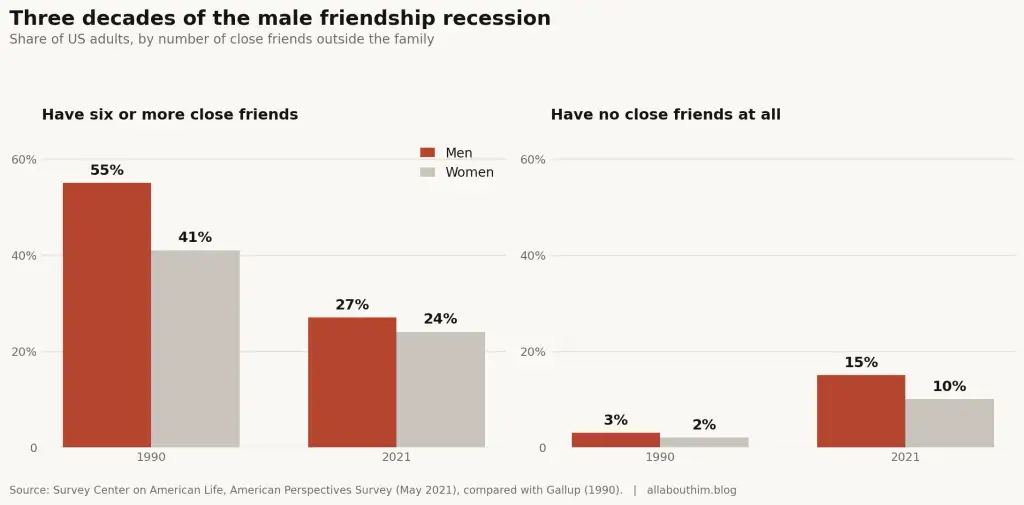
- In 1990, 55% of American men said they had six or more close friends. By 2021 that had fallen to 27%.
- The share of men with no close friends at all rose from 3% to 15%, a fivefold increase.
- Women declined too, but less steeply, which is why this gets described as a male problem specifically.
- The health cost is real and measurable, though it is routinely overstated in headlines.
- The cause is structural rather than emotional. Men did not become worse at friendship. The things that used to supply friendship without effort disappeared.
- What rebuilds it is proximity and repetition, not vulnerability or deep conversation.
What the male friendship recession actually looks like in the data
The figures everyone quotes come from a single source: the Survey Center on American Life’s American Perspectives Survey, conducted in May 2021 and compared against a Gallup poll from 1990.
In 1990, 55 percent of American men reported having at least six close friends outside their family. By 2021, that had fallen to 27 percent. Cut in half in three decades.
At the other end of the scale, the share of men reporting no close friends at all went from 3 percent to 15 percent. A fivefold increase.
Women were not spared. Their six-or-more figure fell from 41 percent to 24 percent, and their friendlessness rate rose from about 2 percent to 10 percent. But the drop was steeper for men at both ends, which is why the phrase attached itself to men specifically.
The number underneath the number
Two findings in that survey get quoted far less often and matter more.
The first: one in five American men who are unmarried and not in a relationship report having no close friends at all. Partnership is doing a great deal of load-bearing work in these figures.
The second undercuts the usual reassurance. Americans with exactly one close friend are not measurably less lonely than those with none, and people with a few close friends are only marginally better off. Among those with three or fewer, more than half reported feeling lonely or isolated at least once in the previous week.
“I have a couple of good mates” is the standard male answer to this question. The data says a couple is not enough to move the needle.
Nobody sets out to lose their friends. It happens through a string of postponed plans, until one day the group chat has been quiet for a year.
What this data cannot tell you
This is where most coverage of the male friendship recession stops being careful, so it is worth being precise about the limits.
These were two separate cross-sections of the population, taken 31 years apart, not the same men followed over time. Nobody watched a single man lose four friends. The surveys were also administered differently, one by phone and one online, and that alone can shift how people answer a question about something as subjective as closeness.
What counts as a close friend may also have changed. A man in 1990 naming six close friends and a man in 2021 naming two may be applying different standards to the same word.
And the comparison cannot isolate a cause. Smartphones get blamed constantly, but the 1990 to 2021 window also contains later marriage, higher geographic mobility, longer working hours, more intensive parenting, and a collapse in the civic institutions that used to organize adult social life. The survey cannot separate those.
None of this makes the finding wrong. The direction and the scale are consistent with a large body of other research on declining social connection. It does mean the honest version of this story is “the population looks very different than it did,” not “your friendships have been stolen by your phone.”
Why the male friendship recession hit men harder
The popular explanation is emotional: men are bad at intimacy, afraid of vulnerability, unable to express feelings. It is a satisfying story and it explains the data poorly.
The structural explanation fits better.
Friendship runs on proximity and repetition
Adult friendships are not primarily maintained by affection. They are maintained by being in the same place repeatedly without having to arrange it. The research on how friendships form points consistently to the same ingredients: frequency of contact, physical proximity, shared activity, and crucially, unplanned interaction.
That last one does most of the work. A friendship that requires a calendar invitation is already in trouble, because the effort of arranging it becomes a tax on every single interaction.
Men’s friendships were built on structures, not on maintenance
Here is the asymmetry that explains the gender gap.
Men’s social lives have historically been organized around institutions that supplied contact automatically: the workplace, the team, the pub, the union hall, the church, the military, the neighborhood. Men did not need to maintain those friendships deliberately, because attendance did it for them.
Women’s friendships, on average, have been maintained more through direct contact independent of any shared setting. Calls, messages, visits arranged for their own sake.
Now consider what happened to those institutions between 1990 and 2021. Jobs became less local and more transient. Religious attendance fell. Union membership collapsed. Neighborhoods became places people sleep rather than places they know. Remote work removed the last reliable source of daily unplanned contact for millions of men.
When the structure disappears, the friendship does not get destroyed. What disappears is the thing that was covering for maintenance nobody was doing.
That is the male friendship recession in one sentence. It is not a deficit of feeling. It is a skill that was never required until suddenly it was.
Why retirement and divorce hit so hard
Both events tend to be described as causes of male loneliness. It is more accurate to call them reveals.
A man who leaves a job after twenty years does not lose friends that day. He loses the mechanism that had been producing contact without any deliberate act on his part. The friendships were real. The infrastructure was borrowed.
The cost, measured honestly
The health claims around loneliness have become inflated, so here are the actual figures.
The most cited source is a 2015 meta-analysis by Julianne Holt-Lunstad and colleagues, pooling data from more than three million participants. Controlling for multiple confounds, it found social isolation associated with a 29 percent increased likelihood of mortality, loneliness with 26 percent, and living alone with 32 percent.
What those percentages mean
They are relative increases, not absolute ones. A 29 percent rise on a small baseline risk is still a small risk. For a healthy 35-year-old man, isolation is not a near-term mortality threat.
The researchers compared the magnitude to the risk associated with grades 2 and 3 obesity, which is a serious comparison honestly made. It is not the same as the “equivalent to 15 cigarettes a day” line that circulates online, which comes from a separate 2010 analysis and has been stretched well past what it supports.
The effect was also stronger in people under 65 than over, which cuts against the assumption that this is an old man’s problem.
The broader point stands without exaggeration. Sustained social disconnection is associated with higher rates of cardiovascular disease, depression, anxiety, and cognitive decline. It belongs on the list of things worth taking seriously about your health. It does not need to be inflated to earn its place there.
The partner problem
There is a specific consequence of the male friendship recession that shows up constantly in relationships, and it rarely gets named as a friendship issue.
When a man’s close friendships thin out, his partner becomes the sole recipient of everything he needs to say. Every worry, every frustration, every piece of processing that would once have been distributed across four or five people now arrives at one address.
Two things follow, and they look contradictory.
Some men overload the relationship, making their partner responsible for all emotional support, which is a load no single person can carry indefinitely.
Far more common, in my experience of how this plays out, is the opposite. The man goes quieter. With only one outlet, the stakes of using it rise sharply. Saying the difficult thing to one of five friends is low risk. Saying it to the only person you have is not, and a great many men respond by saying less.
That has a direct bearing on how conflict goes. A man with no other confidants has more riding on every difficult conversation with his partner, which is part of why men withdraw during conflict more often than women do. The withdrawal looks like a communication problem. Some of it is a friendship problem wearing a different coat.
When you have five people to tell, saying the hard thing is low risk. When you have one, it isn’t.
What actually reverses the male friendship recession
The standard advice is to be more vulnerable and have deeper conversations. It is not wrong, exactly, but it describes the destination rather than the route, and it asks men to start with the hardest available move.
The evidence on how friendships actually form points somewhere much more boring.
1. Choose proximity over intention
Anything that puts you in the same room as the same people on a repeating schedule will outperform any amount of resolve. A five-a-side team, a climbing gym, a weekly game, a run club, a class, a workshop, a regular bar.
The mechanism matters more than the activity. You want contact that happens by default, so that showing up is the only decision and nobody has to organize anything.
2. Make it recurring, not scheduled
“We should get a beer sometime” produces nothing. “First Thursday, same place” produces a friendship in about a year.
A standing arrangement removes the single biggest friction in adult male friendship, which is that somebody has to initiate, and neither person wants to be the one who always does. A recurring slot means nobody initiates. It simply exists.
3. Accept shoulder to shoulder
Men’s friendships tend to be organized around doing something rather than around talking, and this gets treated as a deficiency to be corrected. It is more useful to treat it as a delivery mechanism.
Real conversation between men very often happens sideways, during a drive, a repair, a walk, a round of golf, while both parties are nominally doing something else. If you want depth, do not schedule a conversation. Schedule an activity long enough for the conversation to arrive on its own.
4. Make the first move worse than it needs to be
Reaching out after two years of silence feels humiliating, which is why it does not happen. But the awkwardness is almost entirely on the sending side. Research on this consistently finds that people underestimate how pleased the recipient will be to hear from them.
The message does not need to be good. “Been too long, are you around Thursday” is sufficient. The quality of the opener has essentially no bearing on the outcome.
5. Give it more time than you think
Estimates from friendship research suggest something in the region of 50 hours of contact to move from acquaintance to casual friend, and a couple of hundred to reach close friendship. Those figures are approximate and come from small studies, so hold them loosely.
The useful part is the order of magnitude. Meeting someone three times and concluding it did not click is not a failed friendship. It is a friendship that has barely started.
What does not work
Trying to restart a dormant friendship with a big conversation. Ten years of silence does not get resolved by addressing the silence. It gets resolved by doing something together and letting the rest catch up.
Treating social media contact as connection. Passive consumption of someone’s life produces the feeling of being in touch without any of the effects. Knowing what happened to someone is not the same as being known by them.
Waiting for a friendship that matches what you had at 22. That intensity came from proximity and unlimited time, not from those particular people. Adult friendships are lower intensity and longer running, and measuring them against university friendships guarantees disappointment.
Waiting to feel like it. Motivation follows contact, not the other way round. Most men who rebuilt a social life did it while not especially wanting to.
Common questions
Is the male friendship recession actually new?
The measured decline is real and covers three decades. Whether it represents a break from a longer historical norm is harder to say, since comparable data does not go back much further. What can be said is that men in 1990 reported substantially larger friendship circles than men do now.
How many close friends should a man have?
There is no clinical number. What the survey data suggests is that one is not meaningfully different from none, and that the benefits appear once you get past three or four. Four is a more useful target than a vague ambition to be less lonely.
Does having a partner solve it?
It improves the numbers and it is not a substitute. Partnered men report friendlessness at much lower rates than single men, but routing all social need through one relationship creates its own problems for both people.
Is it too late in your fifties or sixties?
No, but the method matters more with age, because the institutions that used to supply contact are mostly gone by then. This is precisely the stage where a recurring structure, chosen deliberately, does the work that a job used to do for free.
What to take from this
The male friendship recession is one of the better documented changes in modern social life, and it is worth resisting both of the easy readings.
It is not a moral failing. Men did not become emotionally defective between 1990 and 2021. The scaffolding came down, and most men had never needed to build anything underneath it.
It is also not a mystery requiring a personality overhaul. The interventions that work are unglamorous and mechanical. Same people, same place, regularly, for longer than feels reasonable.
Which means the first step is not a conversation about feelings. It is putting one recurring thing in the calendar and going to it even when you would rather not.
More on this in our Understanding Men section.
References
- Cox, D. A. (2021). The State of American Friendship: Change, Challenges, and Loss. Survey Center on American Life, American Perspectives Survey, May 2021.
- Cox, D. A. (2021). Men’s Social Circles Are Shrinking. Survey Center on American Life.
- Holt-Lunstad, J., Smith, T. B., Baker, M., Harris, T., & Stephenson, D. (2015). Loneliness and social isolation as risk factors for mortality: A meta-analytic review. Perspectives on Psychological Science, 10(2), 227-237.
- Holt-Lunstad, J., Smith, T. B., & Layton, J. B. (2010). Social relationships and mortality risk: A meta-analytic review. PLoS Medicine, 7(7), e1000316.
- Gallup (1990). Survey on friendship and social networks, cited as the 1990 comparison point in Cox (2021).



1 Comment