



Share This Article
There is a particular kind of conversation that happens in a lot of households. Something has been wrong for a while. A lump, a cough that will not clear, a pain that comes back. And every time it is raised, the answer is the same: it is probably nothing, it will sort itself out, I will go if it gets worse.
The reason men don’t go to the doctor is usually explained as stubbornness. Male pride, denial, an unwillingness to admit weakness.
Some of that is true and it is measurable. But it is roughly half the story, and the other half is considerably less flattering to how healthcare is organised.
The short version
- 65% of men say they avoid seeking medical attention for as long as possible.
- A 2026 analysis of 2.4 million US cancer cases found men were more likely than women to be diagnosed at a later stage across 20 of 30 cancer sites.
- That pattern held across every racial group and every income bracket, which argues against it being purely about access.
- The men’s health gap is largely not biological. European researchers concluded directly that it is not a biological inevitability.
- Men who hold traditional masculinity beliefs delay care more, prefer male doctors, and disclose symptoms less openly.
- But there is a structural cause nobody mentions: women are routed into regular medical contact in their twenties and thirties by reproductive healthcare. Men have no equivalent entry point.
- Which means the fix is partly personal and partly about building a relationship with a doctor before you need one.
How large the gap actually is
Start with the behaviour itself, because the numbers are not marginal.
In a Cleveland Clinic survey, 65 percent of men said they avoid seeking medical attention for as long as possible. The reasons they gave were being too busy, believing the problem would resolve on its own, and not wanting to appear weak.
The Commonwealth Fund found that when asked what they would do if in pain or feeling sick, roughly a quarter of men said they would wait as long as possible before seeing a doctor. Men living alone were less likely than partnered men to see a physician or receive preventive care at all, which is a finding worth holding onto.
The pattern holds internationally. A large French primary care study covering more than 20,000 patients found women presented at higher rates across every category of complaint, and that men were particularly reluctant to raise certain issues with male GPs.
Why this is not simply about being ill less often
The obvious objection is that men might just be healthier, or complain less because there is less to complain about.
Several studies have tested this and found the disparity persists after controlling for health status. A UK analysis using routine data did find the gap narrowed among patients with existing conditions and among the oldest patients, so it is not uniform. But among healthy working-age adults, where preventive care matters most, it is substantial.
A literature review on men’s help-seeking concluded that the gender gap in primary care cannot be explained by illness prevalence alone, and that gender norms and health beliefs contribute to men’s lower and later use of services.
What it costs
The consequences are not abstract, and the most striking evidence arrived recently.
The cancer staging finding
Researchers analysed the National Cancer Institute’s SEER database, covering 2,401,772 cancers diagnosed between 2015 and 2022. They found men were more likely than women to be diagnosed with regional or distant disease, meaning cancer that has already spread, across 20 of 30 nonreproductive solid tumour sites.
Stage at diagnosis is one of the strongest determinants of whether cancer treatment succeeds. A tumour caught while localised is a different clinical problem from the same tumour caught after it has spread.
What makes this finding difficult to explain away is its consistency. The researchers stratified by race, ethnicity and county-level household income, and the same pattern persisted throughout. If this were primarily about insurance or access, it should have varied with income. It did not.
The wider picture
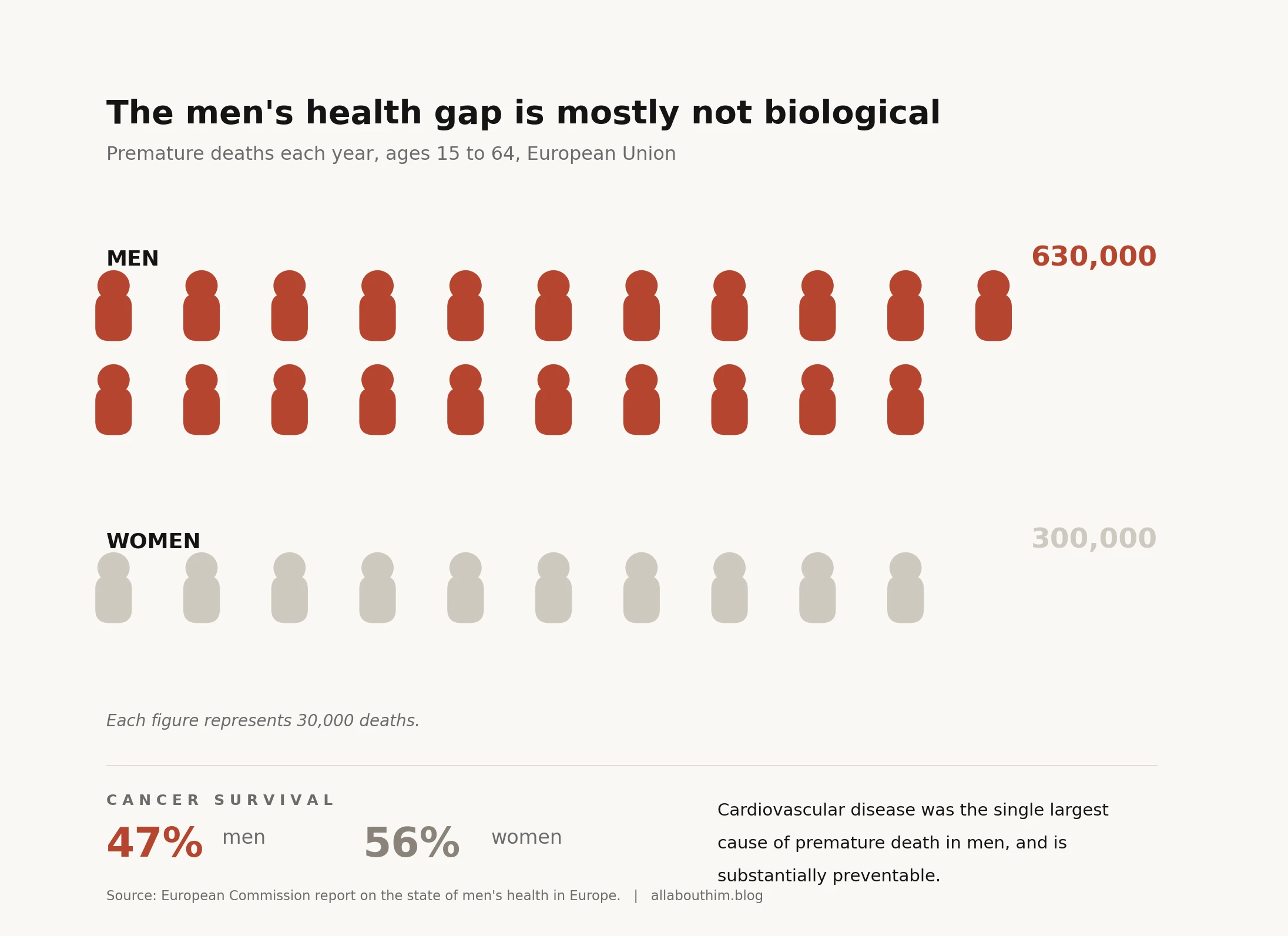
European data tells the same story from a different angle. A report on men’s health in Europe found 630,000 men aged 15 to 64 dying prematurely each year against 300,000 women, with cardiovascular disease the single largest cause. Male cancer survival was 47 percent against 56 percent for women.
The authors’ conclusion is the line worth quoting: men’s health disadvantage is not a biological inevitability.
In the United States, the life expectancy gap between men and women has been widening rather than closing, from roughly 4.8 years in 2010 to 5.8 years in 2021.
The mental health delay
The same pattern appears in mental health, and more severely. Estimates put the average delay between depression symptoms beginning and a man seeking treatment at somewhere between six and nine years.
Part of this is a recognition problem rather than a willingness problem. Men are less likely to present with the textbook description of feeling sad, and more likely to arrive with irritability, anger, fatigue, sleep problems, increased drinking, or physical complaints like headaches and chronic pain. The man often does not recognise it as a mental health issue, and a busy clinician can miss it too, because the patient is not describing it in mental health language.
Across 20 of 30 cancer sites, men arrived later. The pattern held across every income bracket, which is what makes it hard to blame on access alone.
The explanation everyone gives
The standard account is masculinity, and there is real evidence behind it.
Research by Himmelstein and Sanchez found that men who endorse beliefs about men being tough, self-reliant and brave were less likely to seek preventive care and more likely to delay when injured or ill.
A second finding from the same work is stranger and more revealing. Those men preferred male doctors, partly because they believed male doctors were more competent. But when the researchers examined how men actually communicated, the preference worked against them. Men disclosed symptoms less openly to male doctors, in part because of embarrassment.
So the preference produced the opposite of what it was for. A man chooses a male doctor because it feels less exposing, then tells that doctor less. If you are not honest about symptoms, you cannot be treated properly for them.
Health literacy is part of it too
Knowledge of warning signs, symptom awareness and understanding of why early intervention matters have consistently been found to be lower in men than women. This is not an intelligence gap. It is an exposure gap, and it follows directly from spending less time in medical settings.
Which brings us to the part of this story that almost never gets told.
The structural reason men don’t go to the doctor
Consider how a typical woman’s relationship with the medical system develops between the ages of 20 and 45.
Contraception. Cervical screening. Pregnancy, if it happens, which involves an intensive sequence of appointments over months. Postnatal care. For many women, that adds up to regular, repeated contact with a doctor across two decades, most of it when they are perfectly healthy.
The effect is that she acquires a doctor, a medical record, a familiarity with the process, and a low barrier to raising something new. Making an appointment is not a decision. It is a thing she already does.
Now consider the equivalent for a man. There is none.
Outside of injury, a healthy man in a developed country can go from his late teens to his fifties with almost no routine medical contact. Nothing in the system requires him to be there. As one men’s health organisation put it, a man’s first contact with a physician is likely to happen when he first experiences symptoms of something that has been progressing silently for decades. By the time he reaches an emergency room with chest pain, the moment to counsel him about smoking or check his cholesterol has long passed.
Why this matters more than it sounds
It reframes the whole problem. The question is not only why men refuse to go. It is that men are asked to do something from a cold start, at the exact moment they feel worst, with no existing relationship, no familiarity with the process, and no practice.
A woman raising a worrying symptom is usually adding one item to an existing relationship. A man raising the same symptom is frequently initiating that relationship from scratch, for that reason, which is a substantially higher barrier.
Masculinity beliefs then sit on top of this and make a high barrier higher. The two explanations are not competing. One is the terrain and the other is the weather.
There is a third factor too. A man with no close friends has nobody outside his household telling him to get something checked, which is a real route by which people end up at a doctor. Given the documented collapse in male friendship over recent decades, that informal prompting system has thinned out considerably.
She is adding one item to a relationship that already exists. He is starting the relationship from scratch, on the worst day of the month to do it.
What actually changes this
Five things, ordered by how much difference they make.
1. Register with a doctor while you are well
This is the single highest-value action on the list and it is almost never framed as the main one.
The barrier is not the appointment. It is the cold start. Registering with a practice, attending once, and having someone who has your history on file converts every future decision from “should I initiate this” into “should I mention this.” Those are different sized asks.
Do it in a year when nothing is wrong. That is precisely when it is easy.
2. Book the baseline check
Blood pressure, cholesterol, blood glucose. All are asymptomatic for years and all are treatable when caught. Cardiovascular disease is the largest single contributor to premature male death and is substantially preventable.
Ask your doctor what is appropriate for your age and family history rather than working from a list you found online.
3. Write it down before you go
Men disclose less in consultations, particularly when embarrassed, and a ten-minute appointment moves fast. Three bullet points on your phone, written calmly the day before, substantially improves what gets covered.
Put the thing you are least comfortable saying first. It will not get said otherwise.
4. Choose a doctor you will actually talk to
The research on doctor gender preference is worth taking personally. If you would be more honest with a female doctor, that matters more than which gender feels more comfortable to choose. Disclosure is the whole point of the appointment.
5. Set a trigger rule in advance
“If it gets worse” is not a rule, because it has no threshold and no deadline. “If this is still here in two weeks, I book” is a rule. Deciding it in advance removes the judgement call from the moment when you are least inclined to make it.
If you are the partner or friend of someone in this position, note that offering to book the appointment is more effective than urging them to. It removes the step where the decision actually stalls.
What the evidence cannot tell you
Three honest limits.
The cancer analysis shows association, not causation. The researchers were explicit that they cannot establish sex itself caused later diagnosis. Biological factors may contribute, including the possibility that some tumours grow faster in men. The SEER database also lacked information on insurance and healthcare use that might explain part of the pattern.
The gap is not uniform. It narrows among older patients and among those with existing conditions. It is largest among healthy working-age men, which is also where prevention matters most.
Access is a real factor, not only attitude. Uninsured men are at far higher risk of not getting needed care, and in the US the gaps between ethnic groups are large. Nothing in this article should be read as suggesting that a man who cannot afford care is simply making a choice.
Common questions
How often should a healthy man see a doctor?
There is no single interval that applies to everyone, and recommendations vary by country and by age. The more useful question is whether you have a doctor at all, and whether your blood pressure and cholesterol have been checked in recent years. Ask a clinician what schedule fits your age and family history.
Is this just men being stubborn?
Partly. Masculinity beliefs are measurably associated with delayed care. But the structural point matters: men have no routine entry into the healthcare system in early adulthood, so every visit begins from a colder start than it does for women.
Why do men delay mental health treatment for so long?
Recognition is a large part of it. Male depression frequently presents as irritability, anger, fatigue, sleep problems or increased drinking rather than as sadness, so neither the man nor sometimes the clinician identifies what is happening. The same withdrawal pattern that shows up in conflict at home also makes it harder to say any of this out loud.
Does having a partner make a difference?
Yes, measurably. Men living alone are less likely to see a physician or receive preventive care than partnered men. A great deal of male healthcare engagement happens because somebody else pushed for it, which is worth knowing whether you are the man or the somebody else.
Are men’s health clinics a good route in?
They lower the barrier, which is genuinely valuable. Be careful about the ones whose diagnostic process concludes in selling you a subscription, a point we looked at in detail in the testosterone decline story. A clinic that will tell you nothing is wrong is worth more than one that always finds something.
What to take from this
Men don’t go to the doctor, and it shows up in cancer staging, in survival rates, and in a life expectancy gap that has been widening rather than closing. That much is not in dispute.
What is worth revising is the explanation. The stubbornness account is real and incomplete. Underneath it sits a system that gives women two decades of routine medical contact while offering men essentially none, so that every visit a man makes has to be initiated from nothing.
Which is better news than the alternative, because it suggests something concrete. The hard part is not the appointment. It is the first one. Register while you are well, and every decision after that becomes a smaller one.
More in our Health section.
References
- SEER 21 registry analysis of 2,401,772 cancers diagnosed 2015 to 2022, on stage at diagnosis by sex across 30 nonreproductive solid tumour sites (2026).
- Cleveland Clinic, MENtion It survey on men’s health-seeking behaviour.
- Sandman, D., Simantov, E., & An, C. Out of Touch: American Men and the Health Care System. The Commonwealth Fund.
- Galdas, P. M., Cheater, F., & Marshall, P. (2005). Men and health help-seeking behaviour: literature review. Journal of Advanced Nursing, 49(6), 616-623.
- Himmelstein, M. S., & Sanchez, D. T. Research on masculinity, help-seeking delay and doctor gender preference, summarised in The Conversation.
- Reasons for encounter in primary care among French patients (2026). PLOS One. 20,613 patients, 128 GPs.
- Baker, P., et al. The men’s health gap: men must be included in the global health equity agenda. PMC4147416.
- European Commission report on the state of men’s health in Europe, as summarised by the Bureau of Men’s Health.
This article summarises published research and is not medical advice. If something is worrying you, speak to a qualified doctor rather than deciding from an article.
If you are struggling with your mental health, support is available. In the US you can call or text 988. In the UK, Samaritans can be reached on 116 123. Elsewhere, findahelpline.com lists services by country.

